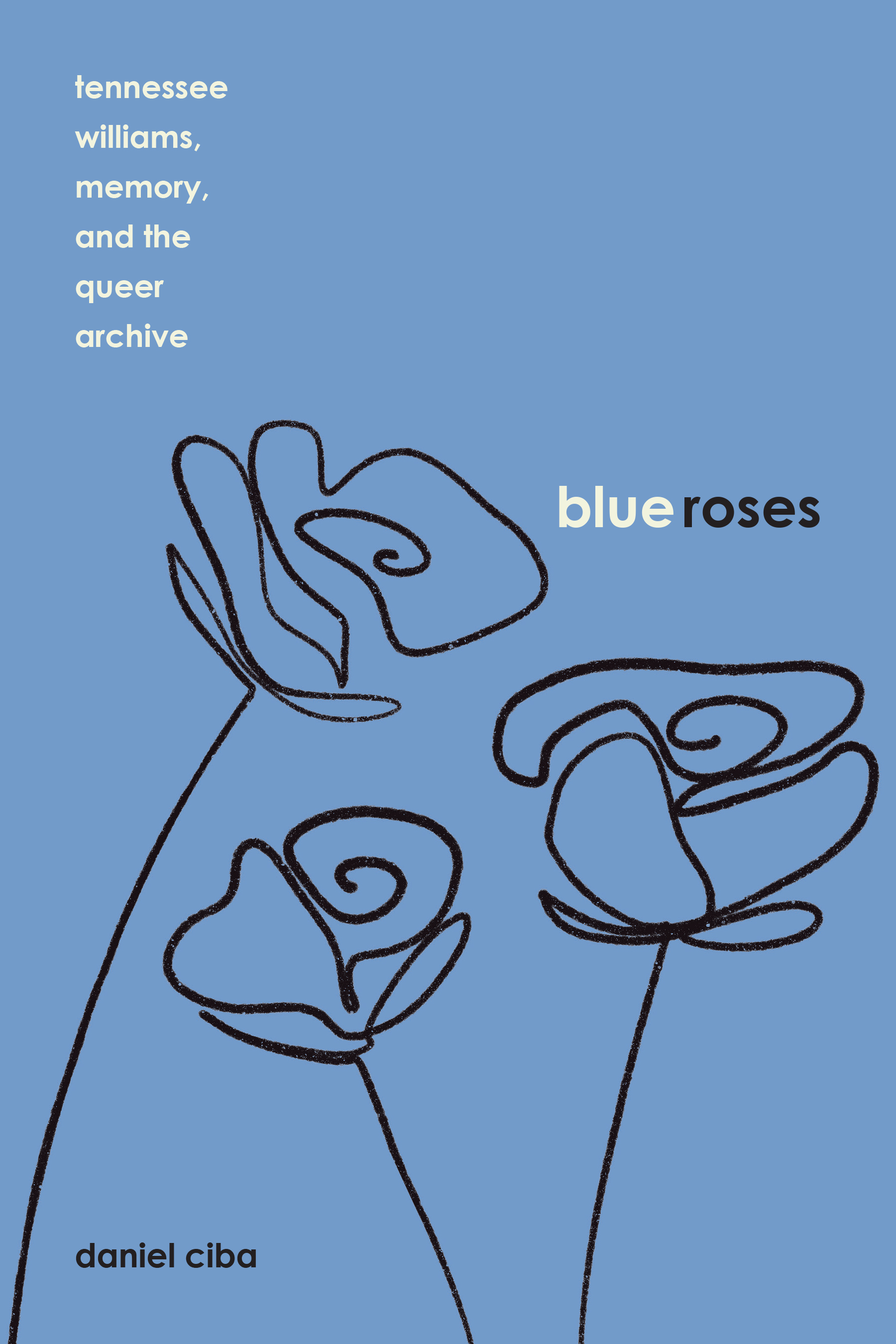
Blue Roses documents a queer response to one of the most popular American playwrights of the twentieth century: Tennessee Williams. Referencing Williams’s symbolic nickname for Laura in The Glass Menagerie, Daniel Ciba arranges archival memories that provoke, resist, and reimagine Williams’s contribution to LGBTQ+ culture. Ciba theorizes new archival methodologies that blend memory studies, queer theory, and theatre historiography. Each blue rose is an untold story of queer history that corresponds to a different period of Williams’s life, from World War II to the Lavender Scare and the Stonewall uprising.
“Daniel Ciba offers a fresh and thoughtful queer reading of Tennessee Williams’s work, tracing how memory, desire, and performance intersect in the plays and their afterlives. This is a valuable contribution to Williams scholarship.”—Eric Colleary, curator of performing arts, Harry Ransom Center
“So many fresh insights into Tennessee Williams emerge from this ‘not about Tennessee Williams’ exploration of same-sex desire among his associates! Daniel Ciba took a turn-every-page approach as he scoured multiple archives to discover connections—blue roses—that long lurked in letters, journals, unpublished manuscripts, contracts, and photographs, all awaiting their decoder. Ciba follows up on floral and feline metaphors in Williams’s work and in those he influenced, including writers of fan letters to Williams. I found the section on ‘Texas Tornado’ Margo Jones particularly illuminating. The originality of Ciba’s monumental undertaking makes it essential for Tennessee Williams studies.”—Felicia Hardison Londré, curators’ distinguished professor emerita, University of Missouri-Kansas City
“In this resonant work of historical imagination, Ciba gathers a veritable bouquet of memories of same-sex desire plucked from Williams’s archives. Feeling his way queerly through an impressive range of collections, some as yet uncataloged, Ciba recognizes ‘blue roses’ strewn by the playwright’s fans, intimates, collaborators, and critics to show alternate dimensions of Williams’s cultural impact and interconnections among LGBTQ+ identities and allyships. This intriguing and often surprising and moving rememoration illuminates historiographical fallacies as it inspires fresh approaches to recovery.”—Kim Marra, University of Iowa
“Daniel Ciba’s Blue Roses is both a study of Tennessee Williams and an argument for use of nonconventional source materials. Ciba has scoured through the vast Williams archives in search of what he calls ‘blue roses,’ often subtle clues as to the playwright’s use of queer sensibilities. Ciba scrupulously tags each floral reference, accumulates them, and then assembles them into a conclusive whole. He is meticulous in distinguishing different degrees of evidence, from the least likely to the most likely. This rigor gives his approach substance. Distinguishing between memory and history, Ciba’s methodology enables the introduction of personal anecdotes and gossip, which further illuminate the dramatist’s process and journey. From a queer point of view, it is interesting that Williams’s greatest successes came in the 1940s and 1950s, though he did not actually come out until a 1970 television interview. Hence Ciba explores the before and after, within the larger context of shifting national attitudes post-Stonewall and Williams’s response to it. Ciba deliberately challenges the findings of a series of major biographies with their implications of direct cause and effect, viewing Williams’s life and work within a more personal context that often illuminates elements in the plays long taken for granted. Because Ciba draws upon a range of source materials, we get rewarding glimpses of the dramatist’s interpersonal relationships and attitudes, from battling with critic Eric Bentley to sparring with Gore Vidal, from the perspective of Margo Jones to that of his executor Maria St. Just. Ciba’s forays into the archives of Esther Merle Jackson are fresh given her stature as a Black woman working in the traditionally white area of twentieth-century American drama. Hence Ciba offers a kaleidoscopic snapshot of a complex and often contradictory figure, one often considered America’s greatest playwright. This is a meaningful addition to the field of Williams studies, one that offers a variety of useful perspectives not available elsewhere and well worth considering.”—Stuart J. Hecht, author, Transposing Broadway: Jews, Assimilation, and the American Musical