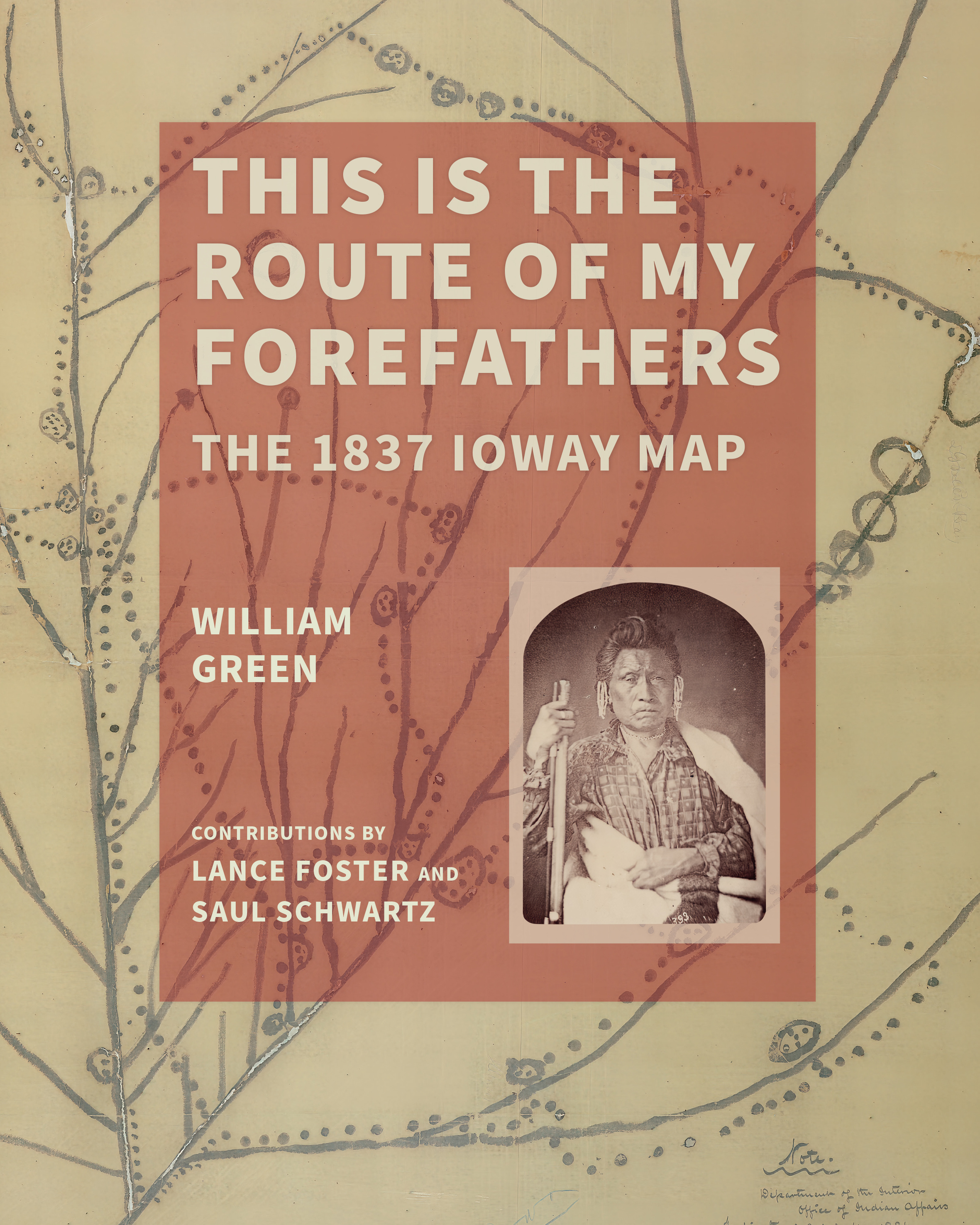
The state of Iowa is named for the Ioways, but most Iowans—and most Americans—know little about them. In This Is the Route of My Forefathers, William Green elevates an understudied history by synthesizing oral traditions, written records, and archaeological data to decode the 1837 map drafted by Ioway leaders. Spanning Indigenous settlements from Missouri to Wisconsin, this map was created to depict tribal history and defend tribal land claims at the height of the Indian removal era.
Illustrating nearly 200 years of Ioway history, the 1837 Ioway map provides insights into the tribe’s political and diplomatic strategies, their relationships with neighboring nations, and how they resisted and negotiated in the face of dispossession. This Is the Route of My Forefathers uses an interdisciplinary approach to reveal how group accounts may fade over time, while accounts of origin—legendary histories—remain rich and vibrant.
“For thirty years, Green could not stop talking about the map of Iowa prepared in 1837 by Ioway chiefs going to Washington to negotiate U.S. demands for their lands. At last, with this book, we all can talk about this remarkably detailed map, clear once we read the identifications worked out by Green and the late Ioway Tribal Historic Preservation Officer, Lance Foster. Green's field archaeology experience evaluates sites labeled Oneota, while Foster's knowledge of his nation's history greatly enriches interpretation of the map. The story they tell of the 1837 negotiations is a significant addition to the political history of the United States' expansion, tribal resistance, and First Nations’ resilience.”—Alice Beck Kehoe, author, Truth and Power in American Archaeology
“This Is the Route of My Forefathers fills a long-standing gap in scholarship on the Ioway people. By weaving together oral traditions, archaeology, and history, William Green continues the vision of Lance Foster—ensuring the Ioway story is honored and remembered.”—Carlton Shield Chief Gover, Pawnee Nation, University of Kansas
“As I was growing up, I learned from my grandparents of many places on No Heart's map. The map confirms the connections and history of our People. William Green speaks volumes about the Ioway people as he tells the history of the map and gives it life! There is so much we can learn from this book.”—Joyce Big Soldier Miller, Iowa Tribe of Oklahoma
“Bill Green has provided the best account to date of this remarkable document [the 1837 Ioway map], and we Ioway appreciate it deeply.”—Lance Foster, from the foreword
“In this book, Green explores one of the most intriguing yet overlooked chapters of theIoway Tribe’s history. . . . Green’s careful research weaves together Native history, archaeology, diplomacy, and cartography, thus inviting readers to travel the map with him and with the Ioway. His clear narrative makes complex topics easy to follow. Given thisthoughtful approach, it is fitting that Green’s book was created with guidance and insight from Ioway tribal members today, including contributions from the late Lance Foster.”—Journal of the Iowa Archaeological Society
“In This Is the Route, readers coming to the No Heart of Fear map for the first time will find careful context, patient reconstruction, and rich illustrations. For the specialist, the rewards run deeper. Green’s historiographical analysis is exacting, his reading of the map’s individual elements meticulous, and his appendices thorough enough that most any question is preemptively answered. It is rare for a book to genuinely serve both audiences. This one does. Green’s collaboration with Lance Foster, the late Tribal Historic Preservation Officer of the Iowa Tribe of Kansas and Nebraska, gives the book a layered quality that no single scholar could have achieved alone. . . . his atlas-style approach is unparalleled among previous studies of the map. This Is the Route of My Forefathers stands poised to become the standard reference on the No Heart of Fear map, joining a growing body of scholarship that treats Native cartography as evidence of complex knowledge systems rather than historical curiosity.”—Kevin Mason, Little Village, Department of History, University of Northern Iowa
Lance Foster
Saul Schwartz