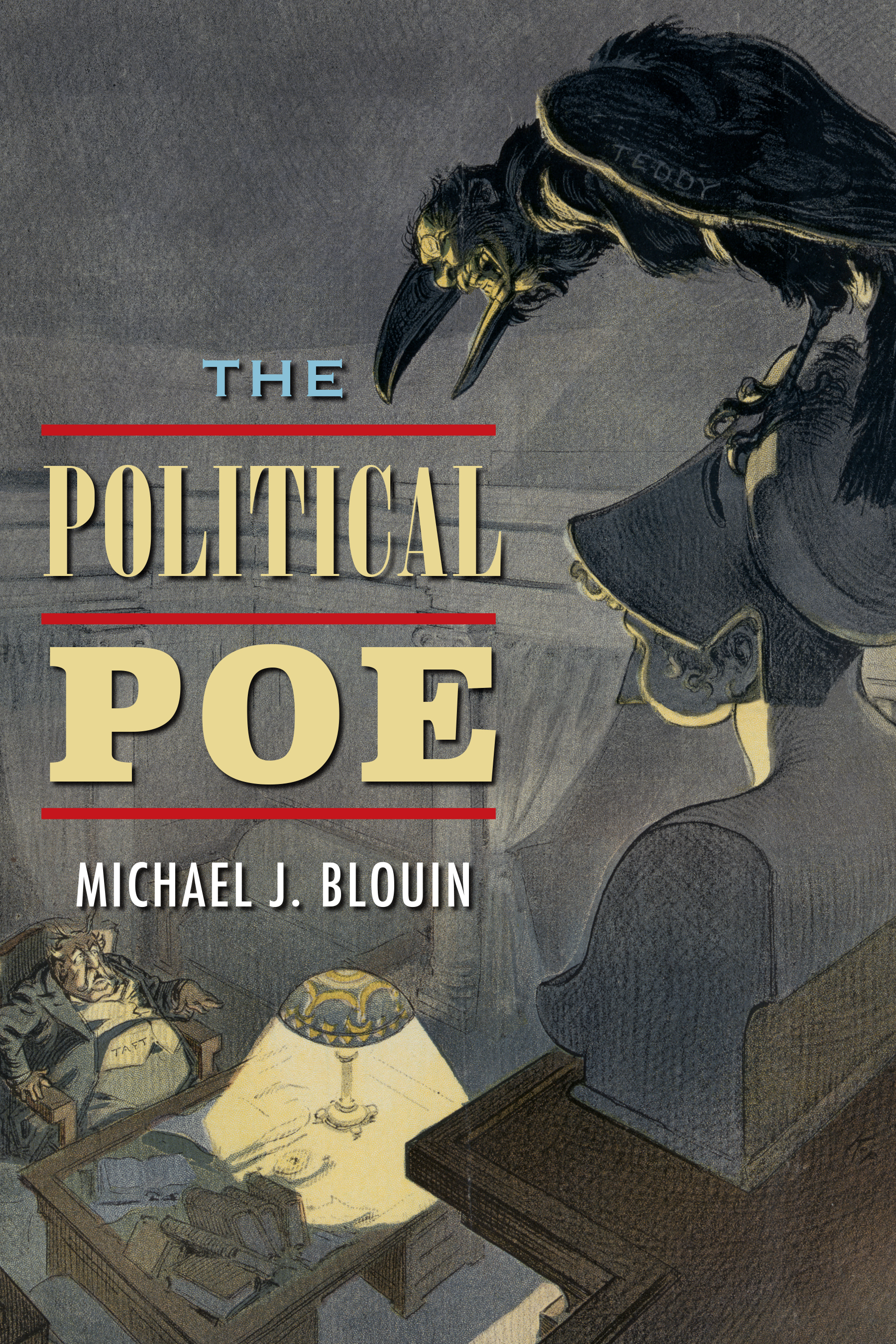
The Political Poe examines the collective works of Edgar Allan Poe through a political lens. While others have gestured toward Poe’s gloomy conservatism, Michael J. Blouin argues that Poe’s reaction against Jacksonian America—with its drift into populism, demagoguery, and what Poe felt was an unhinged politicization of everyday life—mirror the concerns of contemporary American life. Poe consistently denounced democracy. He leveraged racist and misogynistic tendencies. But despite these politics, Blouin uncovers lessons for a world where political thought is antagonistic and every truth has become a battleground for partisan bickering. Here, horror isn’t just a heartbeat beneath the floorboards; it’s a lack of political imagination for what can be created.
“Examining an impressive range of fiction, nonfiction, and poetry, Blouin counters the traditional image of an apolitical Poe, arguing for a surprisingly consistent political disposition, evident across genres and throughout his career. Blouin makes a strong case that Poe’s fear of Jacksonian populism and the excesses of democracy pervade Poe’s work, which speaks to the political crises of our own times as well.”—Scott Peeples, author, The Man of the Crowd: Edgar Allan Poe and the City
“It’s easy to write off Edgar Allan Poe as an apolitical aesthete or a reactionary, would-be aristocrat. Either way, the stories that we tend to tell about Poe can make it seem like he lived through the hyper-politicized Jacksonian Era without absorbing (let alone responding to) the major issues of his day. Michael Blouin’s The Political Poe provides a provocative correction to these tendencies, giving us a Poe who directly and imaginatively responded to the political trends of the early nineteenth century U.S.—trends that are eerily similar to the politics of our own early twenty-first century moment.”—Edward Whitley, Lehigh University